
Interreg BEECH POWER
Project Details
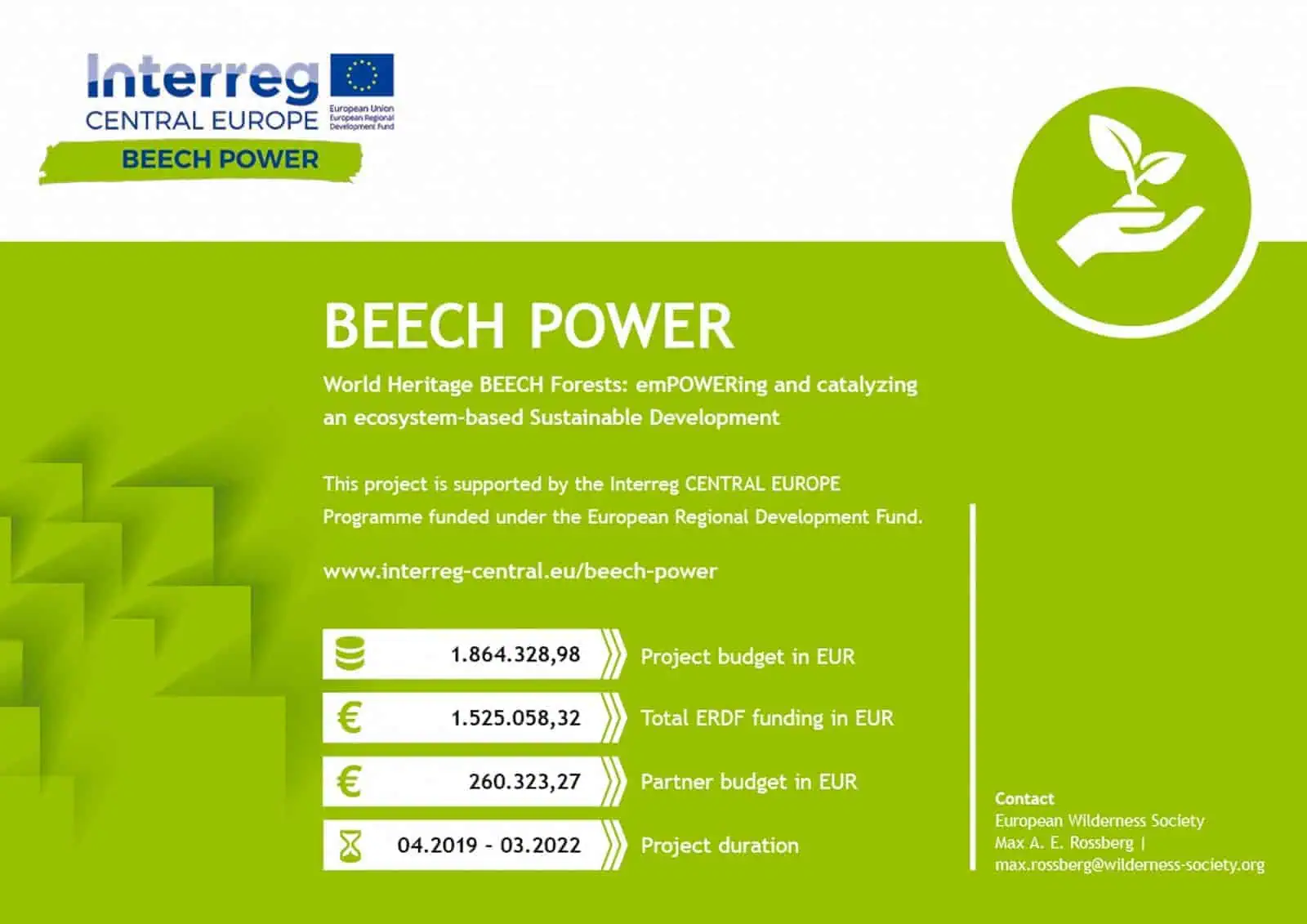
- Project programme: Interreg Central Europe
- Project budget: € 1 864 328.98
- European Wilderness Society budget: € 260 323.27
- Start date: 01/04/2019
- End date: 04/03/2022
- Project website: www.interreg-central.eu/BEECH-POWER
- More information: beechpower.eu
Project Objectives
To develop models for active participation of local and regional public authorities as well as civil society in the management of selected UNESCO Natural World Heritage component parts and their surroundings.
This shall ensure the participation of all relevant governance levels as well as sectors. It will involve public authorities, including municipal governments and Protected Area administrations, as well as SME’s (small and medium sized enterprises) and civil society. Together, joint efforts are made in the wider management of the UNESCO World Heritage component parts to reduce conflicts and create benefits to the UNESCO World Heritage region and the local population. The diverse contexts of the different component parts on which the project focuses, will be taken into account during the development of participatory models. This ensures the transferability to other component parts in Central Europe and beyond, to the entire UNESCO World Heritage site.
To enhance capacities of relevant authorities and stakeholders to improve the overall management quality of the selected UNESCO World Heritage component parts in Central Europe.
This will be achieved by the development of different models, such as the World Heritage Beech Communes, Sustainable Buffer Zone Management, the European Beech Forest Quality Standard, guidelines and trainings. The learning network that facilitates and strengthens collaboration and exchange between practitioners and stakeholders will also contribute to enhance capacities.
Project Partners
- Eberswalde University for Sustainable Development, Germany
- European Wilderness Society, Austria
- Kalkalpen National Park, Austria
- Public Institution Paklenica National Park, Croatia
- Angermünde City Administration, Germany
- Slovenia Forest Service, Slovenia
- National Forest Centre, Slovakia
Workpackages
The project consisted of three main work packages focusing on World Heritage Beech communities, buffer zone management and guidelines for Beech Forest qualities standards.
Work Package T1
Empowering World Heritage Beech communities as model for ecosystem-based sustainable development
The main purpose of this work package was to sustainably enhance the cooperation between protected areas comprising World Heritage component parts an adjacent communities on a regional and transnational level. This was achieved by 3 outputs, which included (i) governance strategies for incorporating natural heritage in regional sustainable development and for actively involving local stakeholders in planning processes, (ii) models for the creation of participatory processes in the surroundings of selected protected areas and (iii) a pilot network of World Heritage Beech Forest communities.
The outputs contributed to the project specific objectives as they focused on active participation of local/regional public authorities and civil society in the management of selected WH component parts and their surroundings by developing relevant strategies in cooperation with decision-making entities and further relevant stakeholders. Furthermore, the outputs contributed to enhancing capacities of relevant authorities and stakeholders through the creation of platforms for mutual exchange of knowledge/experience.
The outputs were reached by an assessment of the stakeholders in the selected target areas before including them in the following steps in joint situation analysis and strategy planning. Apart from developing new strategies/working programs a parallel approach implemented, tested and evaluated 3 pilot measures, which were already identified in former cooperation projects as mechanisms needed for (i) enhancing the cooperation between protected areas and stakeholders in their surroundings, (ii) increasing transnational cooperation and exchange between WH protected areas and (iii) anchoring the WH component parts by the creation of regional added value. The regional strategies developed in 4 target areas and the evaluation results of 3 pilot actions were the basis for the development of overall strategies for other protected areas of the WH site.
Work Package T2
Creation of sustainable model for buffer zone management around World Heritage Beech forests
This work package targeted the buffer zones of PAs comprising WH component parts as border areas with high potential for conflicts between different interest groups but also as areas for regional outreach of the PAs in terms of involving stakeholders in their management, transferring knowledge regarding natural heritage and promoting sustainable development in the region.
The outputs comprised strategies for protected areas and concerned public authorities for active stakeholder participation in buffer zone management, for conflict solution, visitor information and WH communication as well as sustainable forest management, which all contributed to achieving the project specific objectives in terms of mobilisation and active integration of concerned actors in buffer zone managment and regarding capacity building among local stakeholders and public authorities.
Several activities were implemented to achieve these outputs including praticipatory risk assessments of selected buffer zones of WH component parts in Poloniny NP (SK), Snežnik-Ždrocle and Krokar (SI), which included joint strategic planning fo increased stakeholder involvement in buffer zone management and for conflict solutions. Furthermore, strategies for visitor management and concepts for WH knowledge transfer as well as for making the forest experience for visitors and local identification with the WH forest come alive were jointly developed by all partners and partly implemented as pilot activities and evaluated in Kalkalpen NP (AT).
In the framework of another activity all PPs and concerned APs cooperated on the joint development of a guideline for sustainable beech forest management practices in buffer zones of protected areas comprising WH component parts, which was based on a jointly conducted assessment of existing forestry practices in the buffer zones of the target areas. The guidelines were used in a pilot training action for foresters from public and private forestry.
Work Package T3
Development of an exemplary European Beech Forest Quality Standard and Certification System
Within this work package an exemplary European Beech Forest Quality Standard and Certification System was developed that was applicable also to further component parts of the WH site and valuable beech forest areas in Europe. The elaboration of the Quality Standard and Certification System included as outputs:
A study on available management quality standards in conservation
A study on potentials and requirements for an improved management quality in the surrounding of the participating protected areas
A handbook including criteria and indicators for evaluating the conservation status and management quality of beech forest areas.
Furthermore the handbook was meant to support the fulfillment of the reporting requirements of the WH site to UNESCO. By the development of this joint Quality Standard and Certification System the project contributed to the specific objectives as it aimed at catalyzing a better overall management (including buffer zone management) and its contribution to regional sustainable development by relevant public authorities and stakeholders as well as at reinforcing collaboration and exchange across sites and regions. Furthermore the evaluation and certification system aimed at motivating public authorities and stakeholders for active participation in improving the management quality of the beech forests.
These objectives were reached by the involvement of all partners in analysing actually available and applied management quality standards in the conservation sector, interviews in the target areas about potentials and requirements for good management quality as well as workshops with experts related to the European Beech Forest Network for comparing actual monitoring systems and elaborating transparent and comparable criteria and indicators applicable to all component parts of the WH site and further valuable beech forest areas in Europe.
Project Impressions


UNESCO World Heritage Beech Forest Map
| Title | Category | Address | Description | Link |
|---|
